


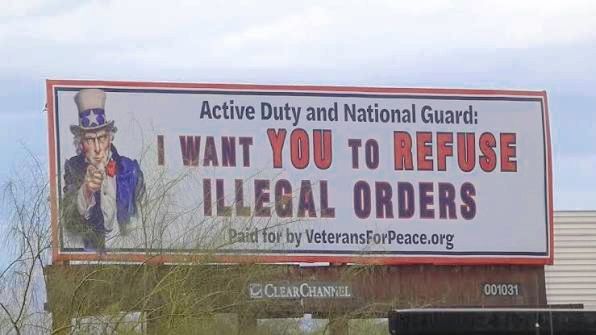
Veterans For Peace is putting up billboards outside military bases with the message, “Refuse Illegal Orders.” A social media campaign is spreading the same message, “Refuse Illegal Orders.” The Trump administration has failed in its persistent efforts to prosecute six members of Congress – veterans of the US military and intelligence agencies – who posted a video message reminding military personnel of their responsibility to “refuse illegal orders.”
So naturally many people are asking the question, just what is an “illegal order?” The Veterans For Peace website gives the following examples:
- Orders to unconstitutionally deploy to US cities in support of racist ICE attacks or to suppress peaceful protests;
- Orders to participate in illegal regime-change wars, such as against Venezuela and Iran;
- Orders to ship weapons to Israel while it is conducting a genocide of Palestinians;
- Order to attack civilians or to torture and kill prisoners of war.
Iran is now the target of a threatened U.S. regime-change war – non-defensive and unprovoked aggression. By the time you are reading thes words, U.S. bombs will probably already be falling on Iran. Should soldiers, sailors, airmen and Marines actually refuse to participate in this war? And what are the consequences if they do?
Iran poses no threat to the U.S. and has not carried out any aggression actions against us. A U.S. attack on Iran would be patently illegal under the UN Charter and international law. No country has the right to intervene, overtly or covertly, in the internal affairs of another nation, or even to threaten such an attack. Furthermore, according to the U.S. Constitution, only Congress has the right to declare war. So a Presidential order to wage war against Iran would clearly violate both international law and U.S. law, as well as human rights and basic morality. So yes – soldiers, sailors, airmen and Marines absolutely have the right and the responsibility to refuse to go to war against Iran.
What will happen to military personnel who are conscientious enough to say “Sir, No Sir?” They are not likely to find much sympathy from their military superiors. Some may be able to declare themselves conscientious objectors who are opposed to all wars. If they are successful they may be discharged from the military with honorable or general discharges. Others may be punished administratively with reduction of rank, forfeiture of pay, and less-than-honorable discharges. Some could even be court-martialed and spend several months in jail.
These are serious consequences, but as many veterans can testify, they pale when compared to the moral injury and PTSD that comes from killing other human beings, whether soldiers or civilians. People who stand up and do the right thing, regardless of the consequences, will actually be doing themselves a big favor in the long run. Legal advice, counseling and support is available from groups such as the GI Rights Hotline, the Military Law Task Force, and the Center on Conscience and War. Political and moral support is offered by groups such as Veterans For Peace and About Face: Veterans Against War.
If military personnel are to take the risks associated with refusing illegal orders, then what is the responsibility of people who are not in the military? It is much easier for them to speak up. They also have the right and the responsibility to resist illegal wars. And civilians usually face far fewer obstacles. Resistance in the military has always been proportional to resistance in U.S. society overall. We must protest and resist – loudly and incessantly. We must join with others in nonviolent protest and direct-action. We must show the courage and resolve that will create space and inspiration for GIs to do the same.
There are many ways to resist war – both inside and outside the military. Resistance can be overt. It can also be covert. During the Vietnam war, some antiwar GIs threw monkey wrenches into the works – in some cases, quite literally. They also organized their brother and sister GIs, held “rap groups,” and published GI newspapers that mocked the generals, the politicians and the war profiteers. Soldiers and civilians came together in “GI coffeehouses,” sharing antiwar stories and “counter-culture.”
The times have changed. Different forms of resistance and organizing are possible now, including organizing online. Many people are in the streets once again, in the hundred and the thousands, resisting the fascist tactics of a militarized ICE, and protesting the aggressive warmaking of the Trump administration. It is time to build a broad-based, mass movement against looming fascism in the U.S. and illegal, immoral U.S. wars. This includes U.S. complicity in Israel’s ongoing genocide of Palestinians.
That movement must first and foremost be in the society at large, but also in the military, where our sisters and brothers, daughters, sons and grandchildren are being ordered to risk their lives limbs, and mental healthy in order to carry out the mass murder on behalf of greedy billionaires.
Those orders are immoral, they are illegal, and they must be vigorously resisted. We mjust refuse illegal orders and resist illegal wars. We must help to build a mass movement for peace at home and peace abroad.
- Gerry Condon, Vietnam-era veteran and war resister who serves on the Veterans For Peace Board of Directors.